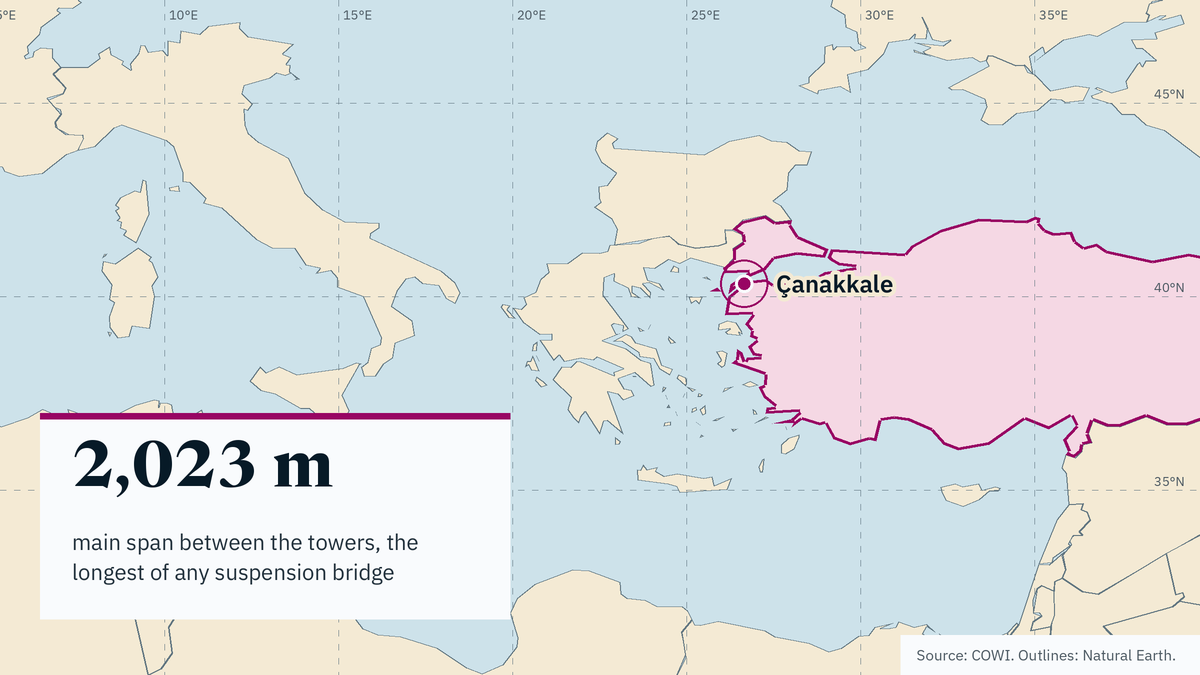
The 1915 Canakkale Bridge carries traffic across the Dardanelles on a main span of 2,023 meters, the longest of any suspension bridge. Turkish and South Korean companies built it for 2.5 billion euros, and a crossing that once meant a ferry wait now takes around six minutes.
Key points
- The 1915 Canakkale Bridge has a main span of 2,023 meters, the longest of any suspension bridge.
- The span length was picked to mark the Turkish Republic’s centenary in 2023.
- Turkish and South Korean companies built it for 2.5 billion euros, about $2.8 billion.
- A Dardanelles crossing that involved a ferry wait now takes around six minutes by road.
- Engineers used a twin-box girder deck to keep the long span stable in wind.
What the 1915 Canakkale Bridge is
The 1915 Canakkale Bridge is a suspension bridge across the Dardanelles, the strait that separates the European and Asian parts of Turkey. A suspension bridge holds its deck from cables slung between towers; the distance between two towers is called the main span. That span is the number people cite when they call a bridge a record holder, and it is measured tower to tower rather than end to end.
That main span is 2,023 meters, the longest of any suspension bridge, according to COWI, an engineering consultancy involved in the design. The figure is a record for the span between towers, not for total bridge length. A long total length can come from approach roads and side spans, which are counted differently.
Turkish and South Korean companies built the bridge for an investment of 2.5 billion euros, about $2.8 billion, CNN reports. That price covers the whole project as reported, not the span alone. Keeping the two numbers apart matters: the span is a measurement of structure, the investment is a sum of money, and one does not explain the other.
Why the span is 2,023 meters
The span length is not only an engineering number. It was chosen to mark the Turkish Republic’s centenary in 2023, according to CNN. The digits of the span and the year of the anniversary are the same, which is how the design brief turns a measurement into a date.
One reading is that the bridge is meant to be read as a statement of national achievement as much as a road project. The cited reports support the link between the 2,023 meter span and the 2023 centenary, while leaving open how the project name itself was finalized. A span chosen for a symbolic reason still has to work as a structure, so the symbolism and the engineering had to be solved together.
How the crossing changes
Before the bridge, crossing the Dardanelles by ferry took about one hour, or up to five hours once waiting time is counted, according to CNN. The bridge cuts the crossing to around six minutes.
That change matters for anyone moving goods or people between Europe and Asia along Turkey’s western coast. A ferry queue is a variable cost: it depends on weather, traffic and schedules. A road crossing is more predictable, which helps freight operators plan journeys.
The time figures compare a ferry journey with a drive. They do not tell us about tolls, traffic at the bridge itself, or how many vehicles use it. A short drive time also says nothing about the cost of the trip, which is set separately from the engineering. The gap between one hour and six minutes is the headline; the gap between five hours and six minutes is what a driver actually feels on a bad ferry day.
The engineering behind the record span
Long suspension spans face a basic problem: wind. A deck that is too light or too solid can start to move in a steady wind, so designers shape the deck to let air pass and to break up the forces that build up along it.
On this bridge, engineers used a twin-box girder deck to keep the long span aerodynamically stable, according to COWI. A girder is the beam that forms the deck; a twin-box design uses two hollow sections with a gap between them, which changes how wind flows around the structure.
The engineering reports describe the deck choice and the span without detailing tower height or cable specifications. What they do show is that the record span and the deck design were treated as one problem, not two: the longer the span, the more the deck has to answer for in wind.
What to watch
The record is a moving target. Span records are broken as new bridges are planned, and available engineering records do not state whether any active project is designed to exceed 2,023 meters.
For Turkey, the open questions are practical: how the 2.5 billion euro investment is recovered, what tolls apply, and how traffic divides between the bridge and the ferries it was built to replace. None of those figures appear in the cited source reports.
What the public records establish is the core of the story: a 2,023 meter span, a 2.5 billion euro price tag shared by Turkish and South Korean builders, and a crossing cut from a ferry wait to around six minutes, as reported by CNN and COWI. Readers who want to follow the project should watch for traffic and toll data, which would show whether the time saving translates into use.