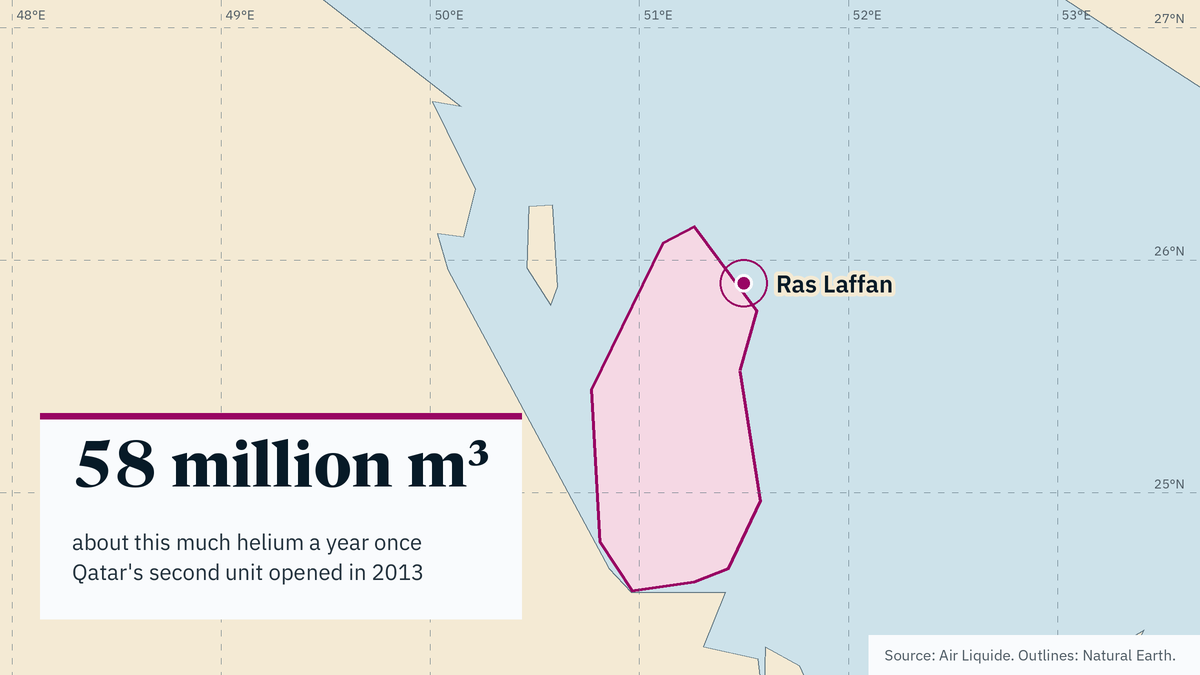
Qatar helium production comes from natural gas processing, so it moves with the country’s LNG output rather than with helium demand. Air Liquide said capacity reached about 58 million cubic meters a year with a second unit in 2013. In January 2026 QatarEnergy signed a long-term supply deal with Air Liquide, and Qatar’s energy minister says North Field LNG expansion will more than double helium capacity.
Key points
- Qatar’s helium capacity reached about 58 million cubic meters a year after a second unit opened in 2013, per Air Liquide.
- That 2013 unit alone could make about 38 million cubic meters a year, purified and liquefied at -269 degrees Celsius.
- In January 2026 QatarEnergy signed a long-term deal to supply Air Liquide around 300 million cubic feet of helium a year.
- Qatar’s energy minister says helium capacity will more than double because of North Field LNG expansion.
- Helium is used in MRI scanners, semiconductors, fiber optic cable, space exploration and air-bag production.
What Qatar helium production is
Qatar helium production is not drilled for on its own. Helium is separated out during natural gas processing, so the volume a country can sell depends on how much gas it treats and how much helium is captured along the way. That makes helium a byproduct business: the main product is liquefied natural gas (LNG), gas cooled to liquid form so it can be shipped, and helium comes out of the same processing chain.
Qatar’s position in this business was set out by Air Liquide, which said that with a second unit opened in 2013 the country’s helium capacity reached about 58 million cubic meters a year. On that basis Qatar was the world’s second largest producer, with 25% of global output at the time.
The same announcement gave the size of the new unit: it alone could produce about 38 million cubic meters of helium a year, purified and liquefied at -269 degrees Celsius. That temperature matters because helium is a gas at room conditions; turning it into a liquid is what makes it practical to store and ship in large amounts.
Why a gas field byproduct reaches chip and MRI supply
Helium is used in MRI scanners, semiconductors, fiber optic cable, space exploration and air-bag production, according to Air Liquide. These are very different industries, and that spread is the point: a single gas stream feeds medical imaging, electronics manufacturing and other sectors at once.
Because helium is essential across these specialised applications, steady supply matters directly to manufacturers and healthcare facilities. Liquid helium purified at extreme low temperatures serves industrial users that depend on consistent purity and volume.
One reading is that this is why a byproduct can carry outsized weight. The helium share of a gas producer’s revenue may be small next to LNG, but for the buyer the gas is hard to replace. Supply risk therefore travels from the gas field to the hospital and the chip plant, not the other way around.
The January 2026 supply deal
In January 2026 QatarEnergy signed a long-term deal to supply Air Liquide with around 300 million cubic feet of helium a year, Qatar News Agency reported. The deal links the state gas company, which runs Qatar’s gas output, to a gas supplier that processes and distributes helium to end users.
The figure is written in cubic feet here and in cubic meters in the earlier Air Liquide announcement, so the two should not be read as a like-for-like comparison of volumes; they are different measures reported at different times. What the 2026 deal shows is a long-term contract rather than spot sales, which gives the buyer a stated annual volume and gives the seller a committed outlet.
This suggests the helium side of Qatar’s gas business is being planned on the same long horizons as LNG. Long-term contracts are how LNG itself is usually sold, and helium appears to be following that pattern.
North Field expansion and the doubling of capacity
Qatar’s energy minister said the country’s helium capacity will more than double because of the LNG expansion projects at North Field, according to Qatar News Agency. The statement ties future helium volumes directly to decisions about LNG trains, the processing units that cool gas into liquid form.
That link is the core of the supply story. If helium is captured during gas processing, then more LNG capacity creates the raw gas stream from which more helium can be extracted. The minister’s statement does not give a new capacity figure, and official announcements do not say when the added helium would come online or how much of it is already contracted.
One reading is that the expansion is a supply signal for buyers in medical imaging and electronics, who watch for long-term volume commitments rather than annual output. A second reading is caution: a plan to more than double capacity is not the same as gas already flowing, and the timing depends on the LNG projects themselves.
What to watch
The open questions are about timing and scale. Public disclosures do not state the current helium capacity, the date the expanded capacity starts, or how the 300 million cubic feet a year in the Air Liquide deal compares with total Qatari output. Readers should treat the figure of about 58 million cubic meters a year as a historical marker and the minister’s doubling statement as a plan, not a measured result.
Watch for three things. First, announcements that tie specific North Field LNG units to helium extraction, which would show the byproduct plan moving with the gas plan. Second, further long-term contracts with gas suppliers, which would indicate how much of the added volume is already spoken for. Third, any published figures in a single unit, cubic meters or cubic feet, so that volumes can be compared without mixing measures.
For chipmakers and hospital equipment buyers, the practical point is that Qatar helium production is set by gas field economics, not by helium demand. A slowdown or delay in LNG work would reach helium users even if their own orders are steady.