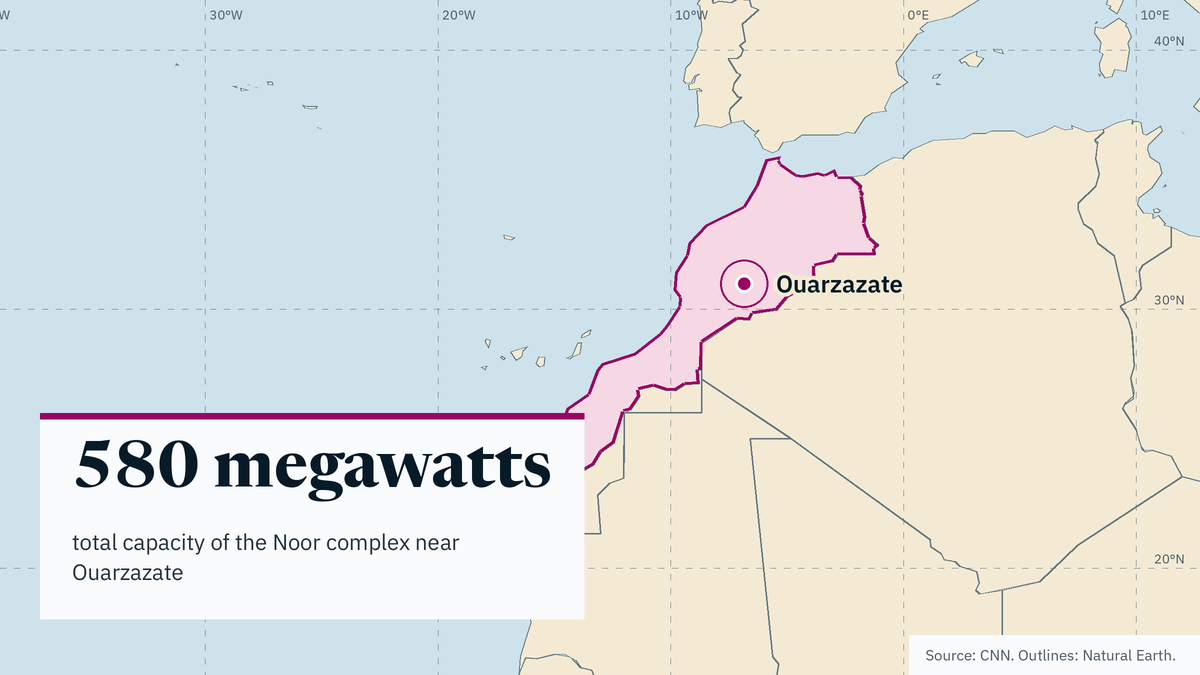
The Noor Ouarzazate solar plant is a concentrated solar complex in Morocco with a total capacity of 580 megawatts, according to CNN, which describes it as the world’s largest concentrated solar farm. The site covers more than 3,000 hectares. Its first phase supplied 160 megawatts of a project valued at $9bn, the Guardian reported.
Key points
- The Noor Ouarzazate solar plant has a total capacity of 580 megawatts, per CNN.
- The site covers more than 3,000 hectares and can supply more than one million homes.
- The first phase supplied 160 megawatts, in a project valued at $9bn, the Guardian reported.
- CNN reported the complex avoids more than 760,000 tonnes of carbon emissions.
- Concentrated solar uses mirrors and heat, not the flat photovoltaic panels most people picture.
What the Noor Ouarzazate solar plant is
The Noor Ouarzazate solar plant is a large solar complex near Ouarzazate in Morocco. According to CNN, it has a total capacity of 580 megawatts and is described as the world’s largest concentrated solar farm.
Capacity means the most power a plant can produce at one time, measured in megawatts. One megawatt is a million watts. A 580 megawatt plant is a utility-scale asset, not a rooftop system.
The same CNN report says the site covers more than 3,000 hectares and can supply more than one million homes. A hectare is about the size of a sports field, so the site is measured in thousands of them.
The complex is built in stages, which is why figures for the whole site and for its first stage differ. The total and the site size describe the complex as CNN reported it, while the first-stage figure below describes an earlier moment in the build.
How the first phase fit into the plan
The first phase supplied 160 megawatts of the planned 580 megawatt capacity, in a project valued at $9bn, according to the Guardian.
In February 2016, the Guardian reported that Morocco’s king was about to switch on that first phase. The date matters for reading the numbers: the 160 megawatt figure describes the plant as it stood at launch, not the finished complex.
The gap between 160 and 580 megawatts is the room left for later stages. The CNN figure of 580 megawatts is the total for the complex as reported in its own article.
The $9bn figure is the value attached to the project in the Guardian’s report. It is a project value, not a price per megawatt, and the cited reporting does not break it down by phase. Nor do the sources say how the cost was financed or who put up the money.
Why concentrated solar is different from panels
Most solar farms people picture use photovoltaic panels, which turn sunlight directly into electricity. Concentrated solar works differently: mirrors focus sunlight onto a receiver, and the heat that builds up drives a power cycle.
The public reporting does not describe storage mechanics or daily generation profiles for the site.
The CNN report ties the complex to more than 760,000 tonnes of avoided carbon emissions, according to CNN. That is an emissions figure, separate from the capacity and site-size figures above, and it should not be read as a measure of how much power the plant makes.
Why it matters
The Noor Ouarzazate solar plant matters first for scale. A 580 megawatt complex covering more than 3,000 hectares, able to supply more than one million homes, is the kind of asset that shapes a national power mix rather than a single town’s supply, per CNN.
Second, it is a test of a technology choice. A country with strong direct sunlight can pick concentrated solar, with its heat-based design, instead of relying only on cheaper photovoltaic panels. The Guardian’s report put the project value at $9bn, which shows the size of the bet.
Third, it is a data point for other sunny countries weighing the same trade-off: capital cost against the kind of electricity a plant can deliver.
One reading is that the complex is as much a statement about industrial planning as about climate policy. That is interpretation, not something the sources state.
What is not known and what to watch
Available public sources leave real gaps. They do not give the plant’s annual electricity output, its capacity factor, or how much of its heat storage is in use. They do not say who owns or operates it, or how its power is priced.
They also do not update the picture. The 160 megawatt first phase comes from the Guardian’s report on the launch, and the 580 megawatt total and the more than 760,000 tonnes of avoided emissions come from the CNN report. Neither tells us what the complex has done since.
For a reader tracking the Noor Ouarzazate solar plant, the useful things to watch are later phases coming online, actual yearly generation, and how concentrated solar costs compare with photovoltaic alternatives in the same market.
Until those numbers are published and checked, treat the 580 megawatt figure as capacity, not as output, and the $9bn as a project value from the Guardian’s report. Capacity tells you what the plant could produce at full tilt; output tells you what it actually delivered over a year. The two are often far apart for solar plants, and the sources provide only the capacity figure.